
Bitcoin Breaks $80K Support: What This Means for BTC Investors
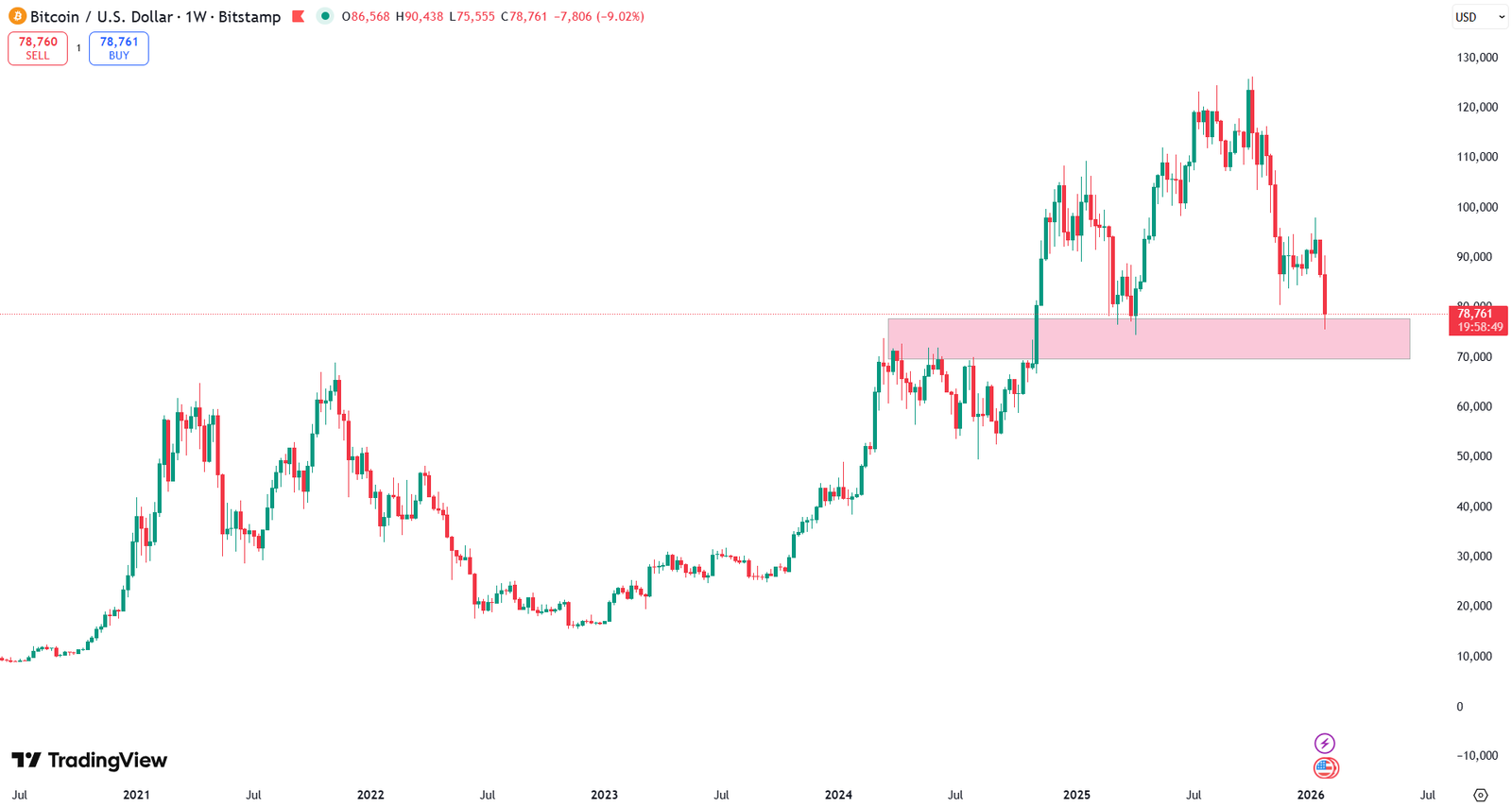
According to me, Bitcoin’s recent move below the $80,000 level marks one of the most important moments of early 2026. Based on the weekly TradingView chart for BTC/USD on Bitstamp, Bitcoin closed the week around $78,641, posting a sharp 9.16% decline. This drop is not isolated—it extends a broader downtrend from Bitcoin’s October 2025 peak near $126,198. In my view, this roughly 38% correction has shifted market psychology from optimism to caution, especially as volatility continues to rise in a thin-liquidity, risk-off environment.
Why the $75K–$80K Zone Has Become a Critical Support Area
I think the $75,000 to $80,000 range is now one of the most important technical zones for Bitcoin. This region is being tested repeatedly, which suggests that buyers are trying to defend it while sellers remain aggressive. According to me, the increased volatility around this zone indicates uncertainty rather than outright capitulation. However, repeated tests of support often weaken it, and this is why the market is extremely sensitive to macro and geopolitical headlines at the moment.
Geopolitical Tensions and the Shift to Risk-Off Assets
In my view, escalating geopolitical tensions have played a major role in Bitcoin’s recent weakness. Rising conflict risks involving the U.S. and Iran, along with broader instability in the Middle East, have pushed investors toward traditional safe-haven assets like gold and silver. I think, Bitcoin is currently behaving like a high-beta risk asset, meaning it reacts more aggressively to global uncertainty. This pattern looks very similar to previous risk-off events, where crypto markets sold off sharply during low-liquidity periods.
U.S. Political Uncertainty and Its Impact on Crypto Markets
As we know U.S. political developments have added another layer of pressure on Bitcoin. President Trump’s nomination of Kevin Warsh as the next Federal Reserve chair has shifted market expectations toward tighter monetary policy. Warsh’s hawkish stance on inflation and liquidity has strengthened the U.S. dollar, which historically reduces demand for speculative assets like Bitcoin. and may be, the partial U.S. government shutdown has also hurt sentiment by freezing progress on crypto-friendly legislation, including the Digital Asset Market Clarity Act, weakening confidence among long-term investors.
ETF Outflows and Institutional Selling Pressure
One of the most direct drivers of Bitcoin’s decline has been massive institutional selling. U.S. spot Bitcoin ETFs recorded more than $1.6 billion in net outflows in January 2026 alone, with a single-day outflow of $818 million. And this is extremely significant because ETFs had been a major source of sustained demand throughout 2025. On-chain data also shows long-term holders distributing roughly 370,000 BTC per month, suggesting profit-taking after last year’s rally. Combined with over $1.8 billion in liquidations within 48 hours, this has intensified downside pressure.
Broader Market Correlations and Miner-Driven Supply Pressure
Bitcoin’s decline cannot be viewed in isolation. The sell-off closely mirrors weakness in tech stocks and certain commodities, as investors rotate capital toward precious metals amid tariff threats and de-globalization concerns. Miner behavior has also contributed to short-term supply pressure. Bitcoin’s hashrate has dropped due to miners reallocating resources to AI infrastructure, extreme winter conditions forcing temporary shutdowns, ongoing restrictions in China, and tariff uncertainty. While this has only temporarily affected network security, it has added to market anxiety.
Fear, Leverage Flush-Outs, and Market Psychology
Sentiment has also played a major role in accelerating this decline. Fear across social media platforms has reached its highest level of 2026 after Bitcoin broke below key support levels near $84,000. And this triggered panic selling and forced liquidations of overleveraged positions. On-chain metrics suggest Bitcoin has entered a deleveraging phase, where excess leverage is being flushed out of the system. Historically, I think this process is painful in the short term but necessary for long-term market health.
Short-Term Outlook – Bearish, but Not Hopeless
According to me, the short-term outlook for Bitcoin still leans bearish due to ongoing macroeconomic and geopolitical uncertainty. If hawkish Federal Reserve expectations persist, ETF outflows continue, and global tensions escalate, Bitcoin could test deeper levels between $50,000 and $70,000. In a worst-case global market shock, even lower levels cannot be fully ruled out. That said, I think such scenarios depend heavily on external factors rather than Bitcoin’s fundamentals alone.
A Stabilization Scenario – Why Sideways Movement Is Possible
In my opinion, a sideways consolidation phase is also a realistic possibility. If U.S. political uncertainty eases, government operations normalize, and ETF flows begin to stabilize, Bitcoin could trade in a range between $70,000 and $85,000. this would resemble previous market resets where leverage cleared before a healthier move emerged. A recovery in mining activity and hashrate could also help form a price floor during this phase.
Can Bitcoin Recover Strongly From Here?
I think a strong bullish reversal is less likely in the immediate short term, but not impossible over a longer horizon. A reduction in geopolitical tensions, renewed progress on crypto regulation, and a shift toward looser monetary policy could restore institutional confidence. And Bitcoin’s long-term fundamentals—including adoption, infrastructure growth, and the delayed impact of the 2024 halving—remain intact. If sentiment changes, long-term holders may stop distributing, allowing price to recover toward $90,000 and beyond.
Final Thoughts – My Take on Bitcoin at This Stage
In my view, Bitcoin’s drop below $80,000 feels dramatic, but it is not unprecedented within a broader bull-market cycle. Historically, Bitcoin has survived multiple 30–40% corrections and still gone on to make new highs. According to me, the current phase is a stress test driven by macro pressure rather than a breakdown of Bitcoin’s core value. Key levels to watch remain support near $75,000 and resistance around $84,000. While short-term risks remain high, Bitcoin’s long-term resilience should not be underestimated.
Friends, this is my personal view and I can be wrong. The crypto market is highly risky and volatile, so please do your own research and consider professional advice before making any investment decisions.
Read More:







2 Comments