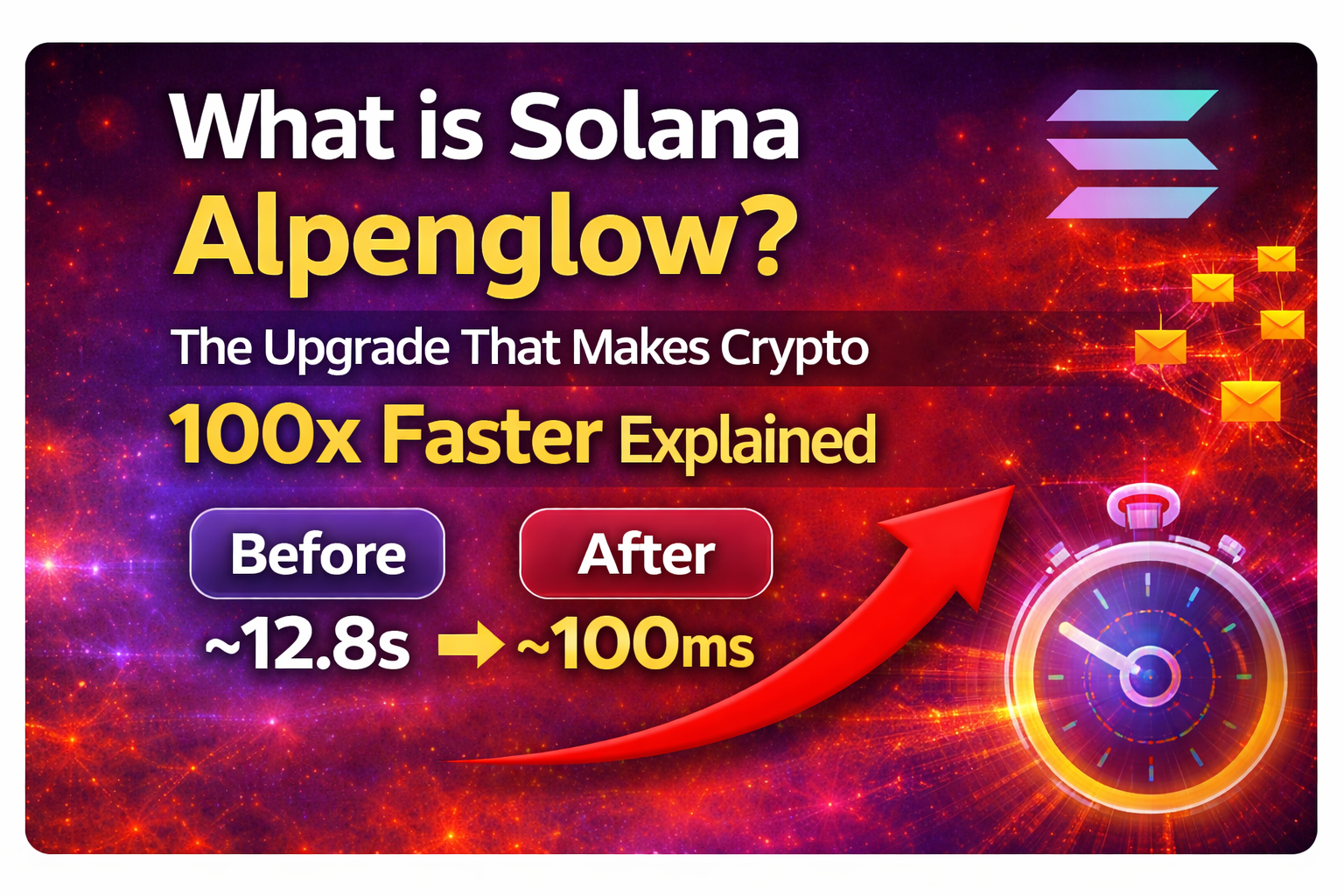
What is Solana Alpenglow? The Upgrade That Makes Crypto 100x Faster Explained
If you’ve been following crypto for even a short time, you’ve probably heard people complain about one thing over and over again- speed. I’ve personally felt this frustration too. Waiting 10–15 seconds for a transaction to finalize might not sound like much, but in a world where we expect instant responses, it feels slow.
That’s exactly where Solana’s Alpenglow upgrade comes in- and honestly, when I first read about it, I thought: this could be one of the biggest technical leaps in blockchain history.
Let’s break it down in simple terms.
What is Solana Alpenglow?
Alpenglow is a major architectural upgrade to the Solana network designed to make it up to 100x faster and significantly cheaper to run.
Right now, Solana already claims to be one of the fastest blockchains. But with Alpenglow, it aims to reduce transaction finality from around 12.8 seconds to just 100–150 milliseconds.
Yes, milliseconds.
To put that into perspective, that’s faster than many credit card authorization systems. When I first compared those numbers, it genuinely changed how I looked at blockchain scalability.
Before vs After — What Actually Changes?
Here’s a simple comparison of what Solana looks like today vs after Alpenglow:
| Parameter | Before (Current) | After (Alpenglow) |
|---|---|---|
| Transaction Finality | ~12.8 seconds | 100–150ms |
| Consensus System | Proof of History + Tower BFT | Votor + Rotor |
| Validator Voting | On-chain (expensive) | Off-chain BLS certificates |
| Block Propagation | Turbine (multi-hop) | Rotor (single-hop) |
| Validator Cost | ~$60,000/year | ~$1,000/year |
| Fault Tolerance | Standard BFT | “20+20” model |
| Block Capacity | Current | +25% planned |
When I looked at this table, one thing stood out immediately: this isn’t just an upgrade, it’s a complete redesign.
The Two Core Innovations: Votor & Rotor
Alpenglow introduces two powerful components that replace Solana’s existing systems.
1. Votor — The New Consensus Engine
Votor replaces the current Tower BFT system. Instead of every validator submitting votes on-chain (which costs money and slows things down), Votor allows validators to:
- Aggregate votes off-chain
- Submit a single cryptographic proof
This might sound technical, but here’s why it matters:
- It reduces network congestion
- It cuts validator costs dramatically
- It speeds up finality
How fast is it?
- Fast Path:
If 80%+ validators agree → finality in ~100ms - Slow Path:
If 60–80% agree → finality in ~250ms
When I read this, I realized something important- Solana is no longer optimizing for seconds, it’s optimizing for milliseconds.
2. Rotor — Faster Data Propagation
Rotor replaces the existing Turbine system. Previously, Solana used a multi-hop relay system where data passed through multiple nodes. That creates delays. Rotor changes this to a single-hop model, meaning:
- Data goes directly to assigned validators
- Less delay, fewer bottlenecks
Key Features:
- Stake-weighted relay assignment
Higher stake = more responsibility - Erasure coding
Even if some nodes miss data, blocks can still be reconstructed - Insane speed
Simulations show block propagation in just 18 milliseconds
I’ll be honest- when I saw “18ms,” I had to double-check if it was a typo. It wasn’t.
Governance & Timeline — Where Are We Now?
Alpenglow isn’t just an idea- it’s already moving through the system.
- May 2025
Whitepaper released by Anza Research - September 1, 2025 — APPROVED
- 98.27% validators voted YES
- 52% stake participation
That level of approval is rare in decentralized systems. When I saw those numbers, it felt like the entire community was aligned on one thing: this upgrade matters.
- December 2025
Testnet rollout and security testing - Q1–Q2 2026 (Current Phase)
Mainnet deployment expected - Later in 2026
Full Rotor rollout + Firedancer upgrade (targeting 1M+ TPS)
Real-World Impact: Why This Matters to You
Now let’s talk about the most important part – why should you care?
Because this isn’t just technical improvement. It directly affects how you’ll use crypto.
1. High-Frequency Trading (HFT)
With 150ms finality, Solana enters a space traditionally dominated by Wall Street systems. For the first time, I think we might actually see:
- Institutional traders using blockchain directly
- Real-time arbitrage without delay
2. Consumer Payments
Imagine sending money as fast as UPI– but without a bank. Alpenglow makes:
- Instant payments possible
- Blockchain competitive with Visa and Google Pay
I genuinely believe this could be the moment crypto payments become practical for everyday use.
3. Gaming & DeFi
Right now, many blockchain games feel slow. With Alpenglow:
- Game actions confirm instantly
- DeFi trades execute without lag
As someone who has tried on-chain apps, I can say this is a huge UX upgrade.
4. Real World Assets (RWA)
Institutions care about one thing: speed + reliability
There are already discussions around tokenized equities and institutional use cases. Instant settlement could unlock:
- Stock trading on blockchain
- Tokenized assets at scale
The Risks & Criticism (Let’s Be Honest)
No upgrade is perfect- and Alpenglow has its critics.
1. Academic Concerns
Muriel Medard raised concerns about Rotor:
- It depends on real-world internet conditions
- Uses older coding techniques like Reed-Solomon
Her argument is simple:
if the network layer isn’t reliable, speed claims may not hold in practice.
2. Centralization Risk
Faster systems often require better hardware.
That means:
- High-performance validators dominate
- Smaller validators may struggle
And I think this is a real concern- because decentralization is the core of crypto.
3. MEV Ecosystem Impact
With 150ms finality, extracting MEV becomes extremely difficult.
This could:
- Reduce unfair advantages
- But also disrupt existing revenue models
So while it’s good for fairness, it may shake up the ecosystem.
Solana Network Growth (March 2026 Snapshot)
To understand the context, let’s look at where Solana already stands:
- 108.8 million daily transactions (peak)
- $15.58 billion stablecoin supply
- 36% global stablecoin transaction volume
- 16 SOL ETFs launched (Oct 2025)
- $100 billion monthly DEX volume
Also, in March 2026, the SEC classified SOL as a Digital Commodity– which is a big regulatory milestone.
When I saw these numbers, it made one thing clear:
Solana isn’t just experimenting anymore- it’s already operating at scale.
My Final Thoughts
I’ll be honest- at first, I thought this was just another upgrade announcement. But after digging deeper, I realized something:
Alpenglow isn’t improving Solana- it’s redefining what a blockchain can be.
- From seconds → milliseconds
- From expensive validation → low-cost participation
- From experimental tech → real-world infrastructure
If this works as promised, we could be looking at a future where:
- Payments are instant
- Trading is real-time
- Apps feel as smooth as Web2
And for the first time, I genuinely think blockchain could match or even beat traditional systems in speed.
So, What Should You Do as a Reader?
Here’s how this helps you directly:
- If you’re an investor → watch Solana closely
- If you’re a builder → this opens new possibilities
- If you’re just curious → this is a major shift worth understanding
Because moments like this don’t come often. And I think- this might be one of them.
Read More:





3 Comments