Government of India Announces ₹8.8 Crore Blockchain India Challenge for Web3 Innovation
India is taking another major step toward digital innovation. The Ministry of Electronics and Information Technology (MeitY) has officially launched the Blockchain India Challenge, a national initiative designed to encourage startups to build innovative blockchain solutions for public governance.
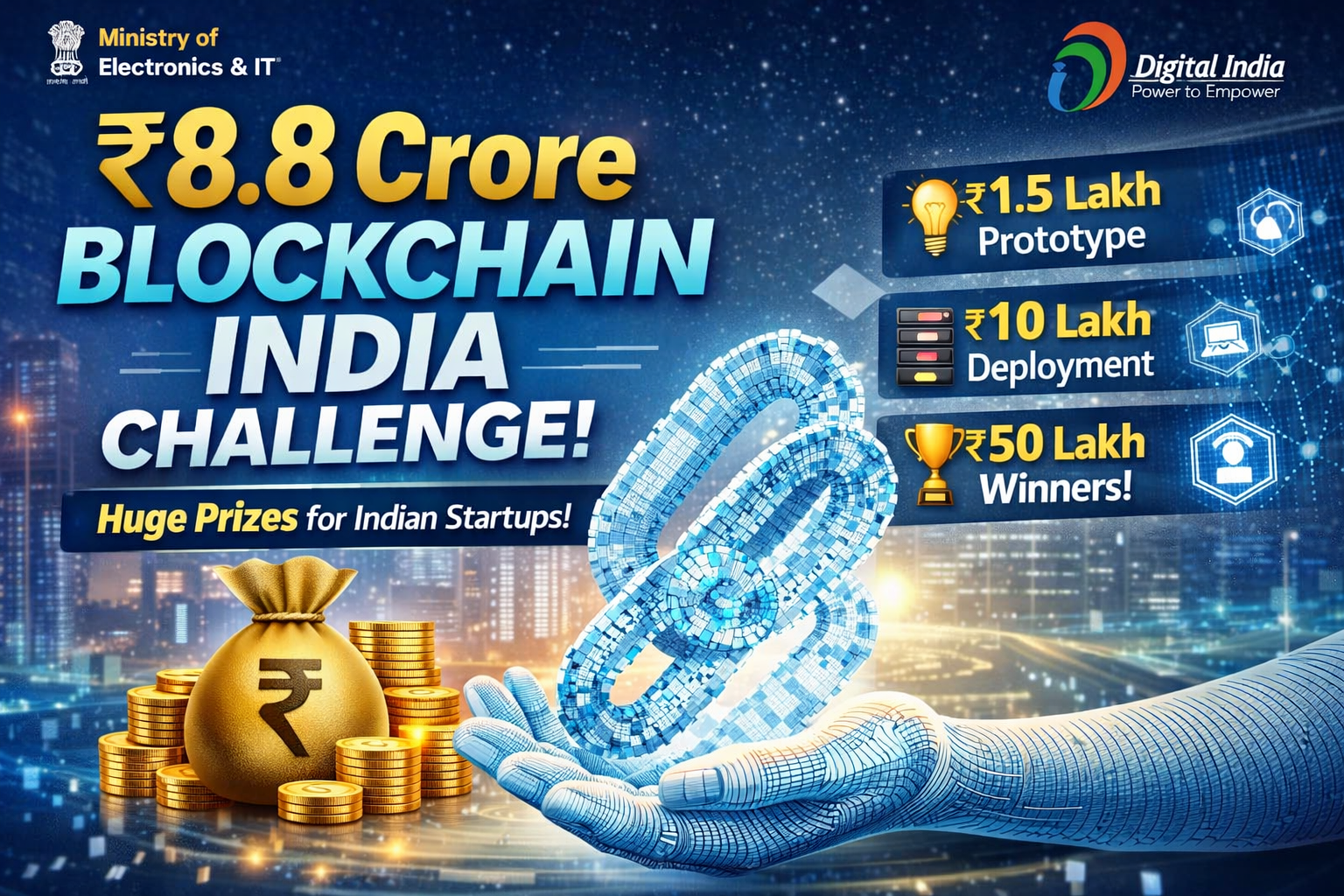
With a total prize pool of ₹8.80 crore, the competition invites Indian startups to develop citizen-centric blockchain and Web3 applications that can transform the way government services operate. The challenge is not just about winning prizes- it aims to create real-world solutions that could be deployed across government departments in India.
Registration and idea submission for the challenge will close on March 27, 2026, at 5:00 PM, and startups interested in blockchain technology have a unique opportunity to participate in one of the largest government-backed innovation programs in India.
What Is the Blockchain India Challenge?
The Blockchain India Challenge is a national innovation program designed to bring together startups, innovators, and government departments to develop new applications using blockchain technology.
The initiative focuses on building solutions that improve:
- Transparency in government processes
- Trust in digital systems
- Efficiency in public service delivery
- Security and tamper-proof record keeping
Blockchain technology is well known for its decentralized and immutable data storage, which means once information is recorded it cannot be easily altered. Because of this, it can be extremely useful in areas such as land records, supply chains, public welfare distribution, identity verification, and many other government services.
Through this challenge, the government wants startups to create innovative Web3-based systems that can solve real problems faced by citizens and government agencies.
Total Prize Pool: ₹8.80 Crores
One of the most attractive aspects of the Blockchain India Challenge is its massive prize pool of ₹8.80 crore, which will be distributed across different development stages.
Unlike many competitions where only a few winners receive rewards, this challenge provides funding at multiple stages, encouraging more startups to participate and develop their ideas further.
Let’s break down the prize distribution.
Stage 1: Prototype Stage
The first stage of the challenge focuses on building a working prototype of the proposed solution.
At this stage, startups must demonstrate that their concept can be converted into a functioning blockchain-based system.
Prize details:
- ₹1.5 lakh per participant
- Up to 40 participants can win
- Total rewards distributed at this stage help teams develop their ideas further.
This stage is extremely important because it filters the best ideas that have the potential to become real products.
Stage 2: Minimum Viable Product (MVP) Stage
The second stage of the competition moves beyond prototypes. Here, startups must build a Minimum Viable Product (MVP)– a functional product that can be tested in real-world scenarios.
Prize details:
- ₹4 lakh per startup
- Up to 30 startups will be selected
At this stage, teams must demonstrate:
- Real functionality of the blockchain solution
- Working features
- A potential use case within government services
Startups that perform well will advance to the final stage of the competition.
Stage 3: Deployment Stage
The final stage focuses on real deployment of blockchain solutions.
At this stage, selected startups must demonstrate that their product can be implemented in real government systems.
Prize details:
- ₹10 lakh for each selected startup
- Up to 20 participants can receive this funding
This stage prepares the startups for real-world implementation with government departments.
Final Winners: ₹50 Lakh Each
After the deployment stage, the top solutions from different use case categories will compete for the ultimate prize.
Final reward details:
- ₹50 lakh for each winner
- 10 winners will be selected
These winners will represent the best blockchain solutions developed under the challenge.
In addition to the prize money, these startups will also gain the opportunity to work directly with government institutions and deploy their solutions at scale.
Competition Structure
The Blockchain India Challenge follows a structured development process.
The competition includes four major rounds:
- Ideation
- Prototype
- Minimum Viable Product (MVP)
- Deployment
Each stage requires startups to improve their solutions and demonstrate increasing levels of technical capability.
Only the best-performing startups move to the next stage, ensuring that the final solutions are strong enough to be deployed in real-world systems.
Mentorship and Technical Support
Participants in the challenge will receive mentorship from experts at the Centre for Development of Advanced Computing (C-DAC) and other industry specialists.
This mentorship will help startups with:
- Technical development
- Blockchain architecture design
- Security implementation
- Business model development
- Deployment strategies
Such guidance ensures that startups not only build innovative solutions but also create scalable and sustainable products.
Major Goals of the Blockchain India Challenge
The initiative has several key objectives.
1. Develop Citizen-Centric Solutions
The main goal is to create technology solutions that directly benefit citizens by improving public service delivery.
2. Increase Transparency in Governance
Blockchain’s transparent ledger system can reduce corruption and ensure accountability in government operations.
3. Encourage Startup Innovation
The challenge aims to strengthen India’s startup ecosystem in blockchain and Web3 technologies.
4. Promote Technology Adoption
By encouraging government departments to work with startups, the initiative helps increase the adoption of blockchain technology in public systems.
Real-World Deployment Opportunities
One of the most exciting aspects of the challenge is that winning solutions will not remain theoretical projects.
Instead, they will be developed into pilot projects in collaboration with government departments. A total of 10 pilot solutions will be deployed, helping demonstrate the real-world impact of blockchain technology in governance.
Startups may also get the opportunity to integrate their applications into the National Blockchain Technology Stack, which could significantly expand their reach.
Important Eligibility Criteria
To participate in the Blockchain India Challenge, startups must meet several eligibility requirements.
Startup Requirements
- Startups must be based in India.
- The startup cannot be a subsidiary of a foreign corporation according to DPIIT guidelines.
Registration Flexibility
Interestingly, startups do not need to be officially registered at the time of application.
However, startups shortlisted for the Proof of Concept stage must apply for startup registration in India.
Age and Citizenship
- All team members must be at least 18 years old.
- Participants must be Indian citizens.
Team Rules
- Only one member per startup can register for the challenge.
- A person cannot be a member of multiple participating startups.
Important Participation Rules
The challenge also includes several important participation rules.
Single Point of Contact (SPoC)
Each startup must nominate a Single Point of Contact who will handle all communication with the organizers. This contact person cannot be changed without permission from MeitY or C-DAC.
Multiple Presentations
Startups may need to present their ideas multiple times during the challenge.
These presentations help the jury evaluate:
- Technical feasibility
- Innovation level
- Practical impact
Intellectual Property Rights
An interesting feature of the challenge is the shared intellectual property ownership.
The intellectual property of solutions developed during the challenge will be jointly owned by MeitY and the startup.
However, if a startup does not commercialize or deploy the solution within 12 months, MeitY reserves the right to transfer those rights to another startup for public benefit.
Use of Open-Source Technology
Participants are allowed to use open-source tools and libraries while developing their solutions.
However, there are several conditions:
- All open-source components must comply with recognized licenses such as MIT or Apache 2.0.
- Startups must document all open-source tools used in the project.
- The core solution must still demonstrate significant original development.
Any evidence of plagiarism or copying existing projects could result in disqualification.
Focus on Non-Crypto Blockchain Applications
One very important rule is that all solutions must be non-crypto blockchain applications.
This means the challenge is not focused on cryptocurrencies.
Instead, it focuses on using blockchain technology to improve government systems, digital governance, and public services.
Examples of possible applications include:
- Land record management
- Healthcare data sharing
- Public distribution systems
- Identity verification systems
- Supply chain transparency
Security, Privacy, and Scalability Requirements
Startups participating in the challenge must also ensure that their solutions meet important technical standards.
These include:
- Strong data security mechanisms
- Protection of user privacy
- High system performance and scalability
- Compliance with government regulations
The architecture must also support API integrations so that government systems can easily connect with the developed solution.
A Major Opportunity for Indian Startups
The Blockchain India Challenge represents one of the largest government-backed blockchain initiatives in India.
It provides startups with:
- Funding support
- Technical mentorship
- Real deployment opportunities
- Collaboration with government departments
- National recognition
For many startups, this could become a launchpad for building large-scale blockchain products that serve millions of citizens.
My Final Thoughts
The launch of the Blockchain India Challenge shows that India is serious about integrating advanced technologies like blockchain and Web3 into public governance.
With a ₹8.80 crore prize pool, structured development stages, expert mentorship, and real-world deployment opportunities, the challenge offers startups a rare chance to turn innovative ideas into impactful solutions.
More importantly, the initiative could lead to the creation of transparent, secure, and efficient digital systems that improve everyday services for citizens.
As the competition progresses, it will be interesting to see what kind of groundbreaking blockchain solutions emerge from India’s rapidly growing startup ecosystem.
Read More:
- How to Convert USDT to INR in india
- Crypto Regulations in India 2026: Legal Status, Tax & TDS Explained
- What Is ISO 20022 in Crypto? Top ISO-Compliant Cryptocurrencies
- What Are Tokenized Assets? A Complete Beginner-Friendly Guide
- What Is CMC20 and How Does It Work?
- Pi Network Price Prediction 2026: How High Could PI Go?
- Top Crypto Exchanges in India for Beginners 2026 Guide