
What Is the Difference Between a DEX and CEX?
If you spend enough time in the crypto world, you’ll eventually hear the same argument echoing everywhere: some investors claim that decentralized exchanges (DEXs) represent the future of finance, while others insist that centralized exchanges (CEXs) are safer, faster, and more reliable.
For beginners, this debate can feel overwhelming—especially when the core question still remains unanswered:
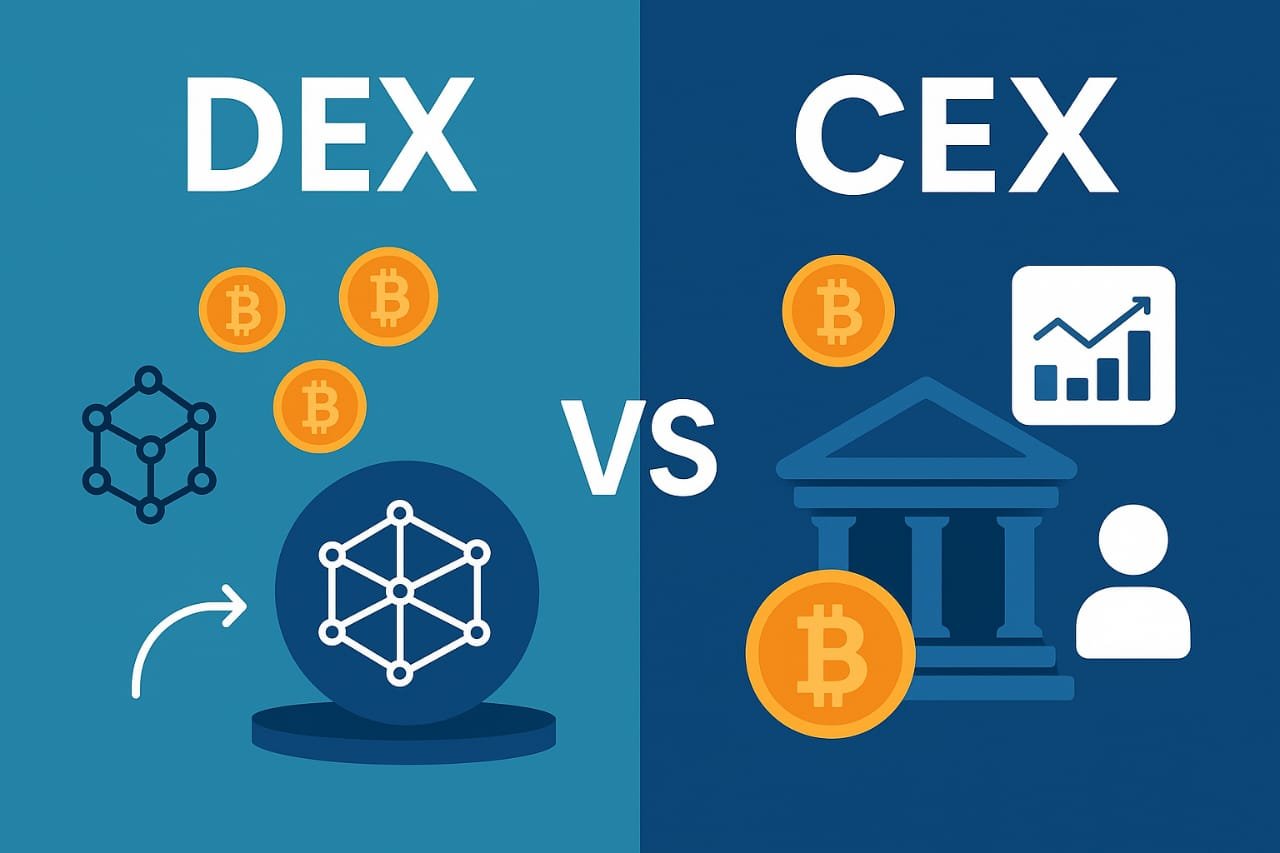
What is the actual difference between a DEX and a CEX?
Imagine you want to buy a packet of biscuits.
Sometimes you purchase it from a large, organized supermarket. Everything is systematic, the environment is structured, and the entire experience is controlled by the store. This resembles a Centralized Exchange (CEX).
Other times, you buy biscuits directly from a street vendor. It’s quick, direct, and there is no formal process. This resembles a Decentralized Exchange (DEX).
This simple analogy captures the underlying difference:
CEX = organised, managed environment
DEX = direct peer-to-peer environment
What Exactly Is a CEX (Centralized Exchange)?
A Centralized Exchange is a platform run by a company that manages user funds, executes trades, and provides a structured trading experience. Popular examples include Binance, Coinbase, OKX and KuCoin.
When you use a CEX, you deposit your funds into the platform. The exchange takes responsibility for storing your assets securely, managing liquidity, and providing tools to trade easily. This makes the trading experience smooth and exceptionally beginner-friendly.
However, there is a trade-off. Because the exchange holds your crypto, you are not in complete control of your assets. If the platform faces a hack, bankruptcy, or internal issues, your funds may be exposed. You’re also required to complete KYC, and the company decides the rules of trading.
What Exactly Is a DEX (Decentralized Exchange)?
A Decentralized Exchange works on a completely opposite philosophy. Instead of depositing your funds into a company’s vault, you trade directly from your personal wallet. Platforms like Uniswap, PancakeSwap, and SushiSwap enable this system.
Here, no company controls your money. There is no KYC, no central authority, and no single point of failure. Your cryptocurrency always stays inside your own wallet, giving you complete ownership and privacy.
The freedom, however, comes with responsibility. There’s no customer support if you make a mistake, gas fees may fluctuate depending on the blockchain, and liquidity may be lower for less popular tokens.
CEX vs DEX: Which One Should You Choose?
Both types of exchanges serve different needs and different types of users.
A CEX is ideal for beginners who want simplicity, structure, and support. The interface is easy to navigate, trades execute quickly, and if you face issues, customer support is available.
A DEX is ideal for users who value independence, privacy, and full ownership of their assets. It is also the preferred environment for accessing emerging tokens early, trading without restrictions, and experiencing the true spirit of decentralization.
In reality, neither option is universally “better.” They simply cater to different preferences, risk levels, and stages of a user’s crypto journey.
The Balanced Perspective:
The growth of the crypto ecosystem depends on both CEXs and DEXs.
Centralized exchanges bring structure, trust, and accessibility for millions of newcomers. Decentralized exchanges maintain the original vision of crypto, offering financial freedom without intermediaries.
For many users, the ideal path is a blend of both:
- Start with a CEX to learn the basics in a safe, organized environment.
- Transition to DEXs once you understand wallets, private keys, and self-custody.
This approach allows you to enjoy the convenience of a CEX and the independence of a DEX — using each platform for the strengths it offers.
I hope you enjoyed reading this article. I’m constantly learning and improving, and my goal is to keep growing my knowledge so I can provide even better value to all my readers.


👍 good