What Are Tokenized Assets? A Complete Beginner-Friendly Guide
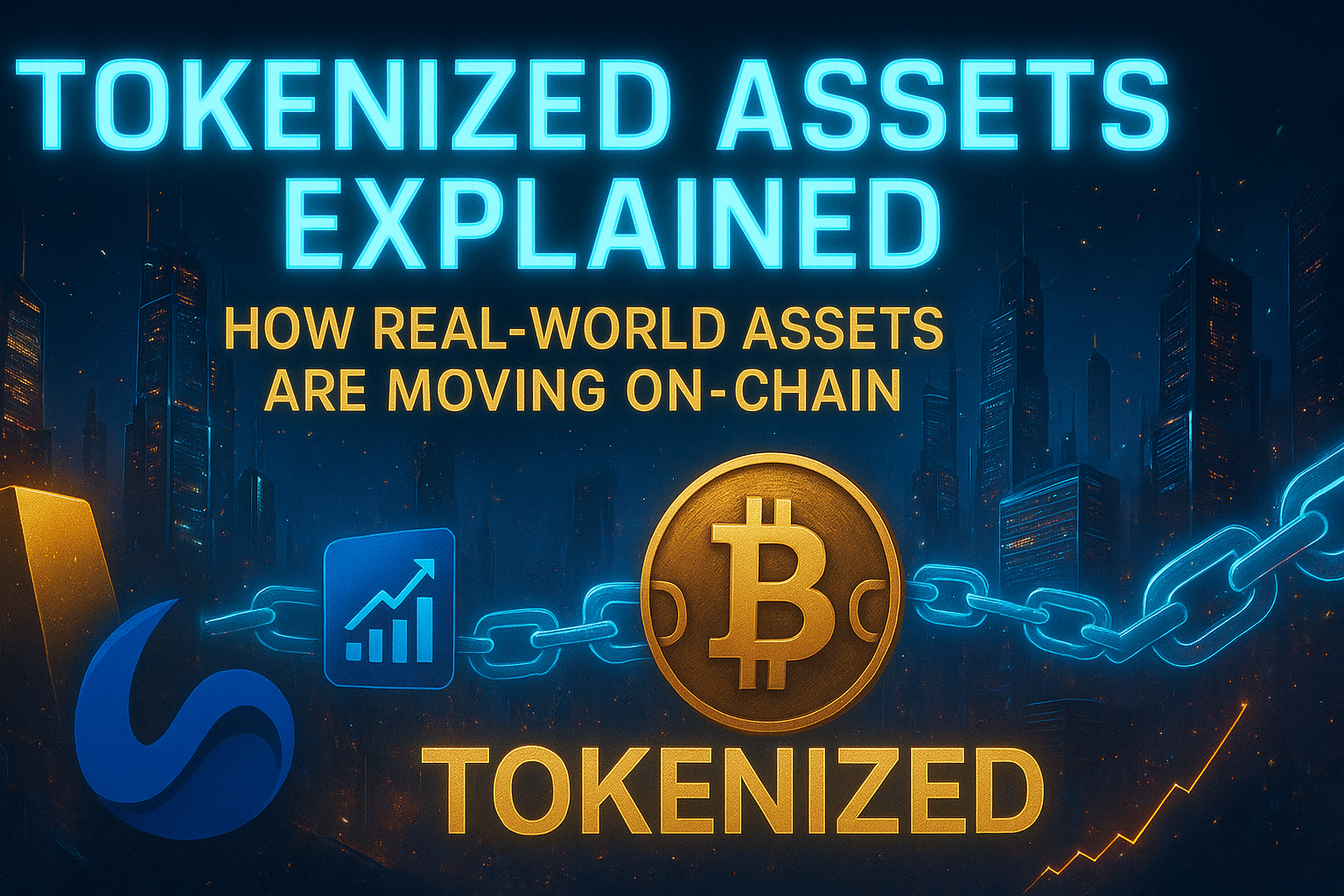
Introduction to Tokenized Assets
If you’ve opened crypto Twitter, watched a finance video, or scrolled through any blockchain thread, you must have seen one phrase everywhere:
“RWA is the future.”
“Tokenized real-world assets will bring trillions on-chain.”
Tokenized assets refer to real-world or digital assets that are converted into blockchain-based digital tokens. In simple terms, tokenization means taking something that exists in the real world—such as gold, real estate, stocks, bonds, or commodities—and representing ownership of that asset through a token on a blockchain.
Each token acts as a digital proof of ownership. If a token is present in your blockchain wallet, it represents a specific share or fraction of the underlying asset. Tokenization connects traditional finance with blockchain technology, decentralized finance (DeFi), and real-world assets (RWAs), making ownership more flexible and programmable.
Tokenization has emerged as a major narrative in global finance and Web3 because it solves several long-standing problems. Traditionally illiquid assets become liquid, markets can operate 24/7 without intermediaries, and smart contracts allow automation of settlement, compliance, and distributions. These benefits are driving strong interest from both crypto-native users and large financial institutions.
How Tokenization Works
The tokenization process begins with the selection of a real or financial asset. This could be physical gold stored in a secure vault, real estate held by a legal entity, or financial instruments such as bonds or treasury bills.
Once the asset is identified, a legal structure is created, often through a special purpose vehicle (SPV) or trust, to hold and manage the underlying asset. This ensures legal clarity and investor protection. After this, digital tokens representing ownership or economic rights are issued on a blockchain using smart contracts.
For example, if a company holds one kilogram of gold, it can issue 1,000 blockchain tokens, where each token represents one gram of gold. If an investor holds 10 tokens, they effectively own the economic rights to 10 grams of gold. These tokens can then be stored in blockchain wallets and traded on supported platforms.
Smart contracts automate issuance, transfers, and distributions, while custodians or trustees secure the underlying assets. Compliance layers such as KYC and AML ensure adherence to regulatory requirements, especially for regulated securities.
Types of Tokenized Assets
Tokenized Financial Assets
Tokenized financial assets include traditional instruments such as stocks, bonds, funds, money market instruments, and U.S. Treasury bills. These tokens mirror the economic rights of conventional securities while offering faster settlement and programmable features.
Tokenized Real-World Assets (RWAs)
Real-world asset tokenization covers physical and revenue-generating assets such as real estate, commodities like gold, silver and oil, invoices, private credit, and revenue-sharing agreements. These assets are typically illiquid in traditional markets but become accessible and divisible through tokenization.
Native Digital Assets
Native digital tokenized assets include NFTs, intellectual property rights, licensing agreements, music and royalty tokens, and revenue-sharing tokens. These assets are often created digitally but still represent real economic value.
Technology Stack Behind Tokenization
Tokenized assets can be issued on public blockchains such as Ethereum and Polygon, or on permissioned and private chains designed for institutional use. Public chains offer transparency and composability, while permissioned chains prioritize compliance and privacy.
Common token standards include ERC-20 for fungible assets, ERC-721 for unique assets, and ERC-1155 for hybrid models. In DeFi-integrated tokenization, protocols such as Maker, Centrifuge, and other RWA platforms enable on-chain collateralization, lending, and yield generation.
Benefits of Asset Tokenization
Tokenization enables fractional ownership, allowing investors to buy small portions of high-value assets. This improves liquidity and broadens market access. Markets can operate 24/7 with faster settlement times and significantly lower transaction and issuance costs.
Smart contracts introduce programmability, enabling automated compliance, dividend distributions, interest payments, and corporate actions. Transparency improves trust, as ownership and transactions are verifiable on the blockchain.
Risks, Challenges, and Limitations
Despite its benefits, tokenization carries risks. Regulatory uncertainty remains a major concern, especially across jurisdictions. Custody risks, smart contract vulnerabilities, oracle manipulation, and issuer trust are critical challenges.
Liquidity can sometimes be an illusion, and thin markets may expose investors to volatility and manipulation. Investor protection mechanisms are still evolving, particularly in decentralized environments.
However, an important development has emerged that directly addresses some of these risks. As of late 2025, the Depository Trust & Clearing Corporation (DTCC) announced that its subsidiary, the Depository Trust Company (DTC), received a No-Action Letter from the U.S. Securities and Exchange Commission (SEC). This authorization allows DTC to operate a three-year controlled-production tokenization service for assets already custodied within the DTC system, with rollout expected in the second half of 2026.
This is a critical signal for the market. Under this framework, traditional assets can be tokenized on approved Layer-1 and Layer-2 blockchains, while the digital versions retain the same legal rights, investor protections, and settlement assurances as their conventional counterparts. While this does not eliminate all risks, it significantly reduces legal ambiguity, custody uncertainty, and counterparty concerns for institutional-grade tokenization.
Regulatory Landscape
In regions such as the United States, European Union, Singapore, and the UAE, regulators are increasingly providing frameworks for tokenized securities and RWAs. Initiatives like MiCA in Europe and sandbox programs in Asia are accelerating compliant adoption.
Global Tokenized Assets Market Cap
Global tokenized real‑world assets have grown rapidly in 2025. Public dashboards show around 18–19 billion dollars in tokenized RWAs actively held on‑chain, linked to roughly 400 billion dollars of represented off‑chain assets, while stablecoins add another ~300 billion dollars to the broader tokenized‑asset universe.

Ethereum dominates the sector with RWA value in the low‑tens‑of‑billions, and Solana has grown to several‑hundred‑million dollars of tokenized assets. Monthly trading volumes across RWA and tokenization platforms are already in the tens of billions of dollars, indicating real usage rather than pure hype.
Leaders like Ondo Finance (about 1.8–1.9 billion dollars in TVL) and BlackRock’s BUIDL tokenized fund (roughly 2.5 billion dollars in AUM) highlight how both DeFi‑native projects and giant asset managers are scaling tokenization, alongside new platforms such as Tether’s Hadron and Amundi’s regulated BENJI tokenized fund.
Future Outlook and Market Predictions for Tokenized Assets
The future of tokenized assets looks massive. Research firms and financial institutions estimate that by 2030, the RWA market could grow from today’s $45 billion to more than $16 trillion. Tokenized stocks could account for $10 trillion, real estate may contribute $4 trillion, and government bonds might add another $2 trillion.
In an even more optimistic scenario — known as the bull case — the market could hit $5–10 trillion by 2028, fueled by better regulation, institutional inflows, and blockchain scalability upgrades. However, challenges such as regulation and security risks could slow things down. The growth is huge, but caution is always necessary.
This article is for education, not investment advice. Please do your own research before putting your money into any RWA token.
Thank you for reading. I hope this helps you understand the world of tokenized assets a little better.
Read More:

18 Comments