How to Buy SpaceX IPO Stock (SPCX): Complete 2026 Guide
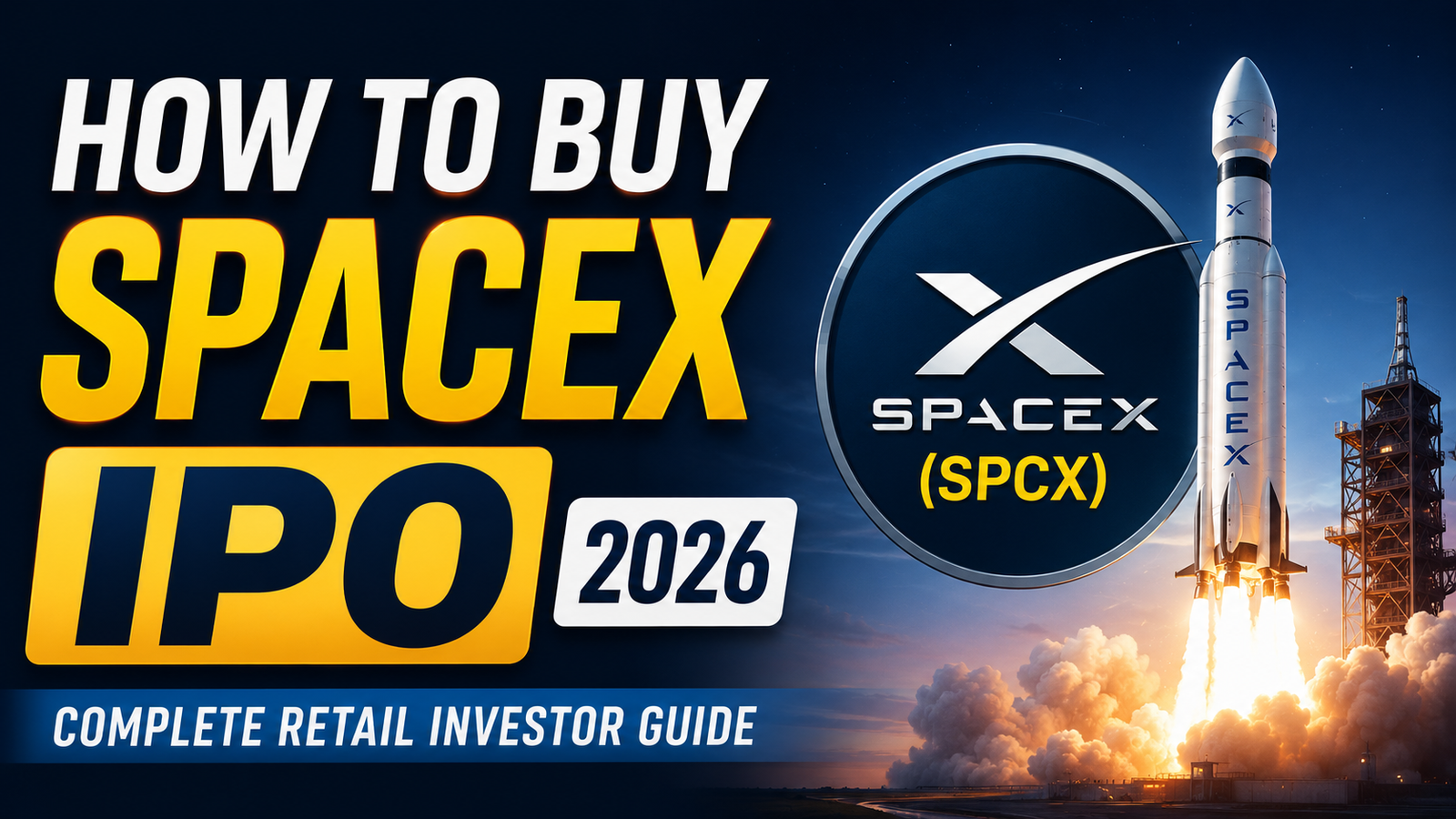
SpaceX is finally doing what many thought would never happen, going public. After years of Elon Musk insisting the company had no need for public markets, the rocket and satellite giant is set to list on the Nasdaq under the ticker SPCX, in what is shaping up to be the largest initial public offering in history. For everyday investors who have watched this company reshape the aerospace industry from the sidelines, the question is no longer if you can buy in, it’s how.
This guide breaks down everything you need to know: what the SpaceX IPO actually is, how to get shares at the IPO price, what to do if you miss the window, and whether you should even be buying in the first place.
What Is the SpaceX IPO?
Space Exploration Technologies Corp., better known as SpaceX, was founded by Elon Musk in 2002. Over two decades, the company built itself into the dominant force in commercial space launches, developed the Falcon 9 and Starship rockets, and launched Starlink, a satellite internet network that now serves millions of subscribers worldwide.
For most of that time, SpaceX remained stubbornly private. That changed in 2026.
The company is now aiming to raise roughly $75 billion by selling over 555 million shares at $135 per share, placing its valuation at over $1.75 trillion. If the underwriters exercise their full overallotment option, proceeds could climb past $85 billion, obliterating the previous record set by Saudi Aramco’s $29 billion listing in 2019.
What makes this IPO genuinely unusual, and worth paying close attention to, is the retail allocation. Most IPOs reserve just 5 to 10 percent of shares for individual investors. SpaceX, reportedly at Musk’s direction, is targeting up to 30 percent of the offering for retail participation. In dollar terms, that’s a potential $20+ billion made available to people like you and me, not just institutional hedge funds and sovereign wealth vehicles.
How to Buy SpaceX Shares at the IPO Price
To participate in the IPO itself, meaning you want to buy shares at $135 before trading begins on the open market, you need to act through one of the five designated retail brokerages SpaceX has officially partnered with:
- Robinhood: via its IPO Access feature (Conditional Offer to Buy)
- Fidelity: requires at least $2,000 in your retail brokerage account
- Charles Schwab: submit a Conditional Offer to Purchase (COTP) through Schwab’s IPO calendar before 4 p.m. on the offer day
- E*TRADE by Morgan Stanley: available to qualifying account holders
- SoFi: submit an Indication of Interest (IOI) through its IPO Center
If you already have accounts with any of these platforms, the process is relatively straightforward. Log into your brokerage, locate the SpaceX IPO listing in the platform’s IPO section, and submit your request to participate. Each platform uses slightly different terminology “Indication of Interest,” “Conditional Offer to Buy,” or “COTP” but the mechanism is the same: you’re telling the broker how many shares you’d like, and the broker will attempt to fill your order at the IPO price.
A few critical things to understand before you hit submit:
Submitting a request does not guarantee you’ll receive shares. IPOs of this magnitude are heavily oversubscribed, and your allocation may come back as zero, a fraction of what you requested, or in some cases the full amount. Fidelity reduced its eligibility threshold from $500,000 in account assets down to just $2,000 specifically for this IPO, which makes access broader than it has been historically, but supply is still finite.
You’ll also want to check the submission deadline for your platform. For Schwab, for instance, requests must be submitted before 4 p.m. on the relevant day. Missing this window means waiting for the secondary market.
What If You Miss the IPO Allocation?
Missing the IPO window doesn’t mean missing SpaceX. Once shares begin trading on the Nasdaq under the ticker SPCX, you can purchase them through virtually any U.S. brokerage, Schwab, Fidelity, Robinhood, Webull, TD Ameritrade, Interactive Brokers, and so on. This is called buying in the secondary market.
The trade-off is price. IPO shares are allocated at the set offering price ($135). Secondary market shares trade at whatever price the market determines once the opening bell rings, and that price can swing dramatically in early sessions. Hot IPOs frequently gap up 20–40% on day one, meaning you’d pay a significant premium over the IPO price. They can also drop. Using limit orders, rather than market orders, is the smart play here, as it lets you define the maximum price you’re willing to pay and avoids nasty surprises during the volatile first hours of trading.
Indirect Ways to Gain Exposure to SpaceX
If you want exposure to SpaceX without buying the stock directly, there are a few routes that have been available even before the IPO:
Alphabet (GOOGL/GOOG): Google’s parent company invested $900 million in SpaceX back in 2015 when the company was valued at around $12 billion. Alphabet currently holds roughly 7% of SpaceX, a stake that, at today’s IPO valuation, is worth well over $100 billion.
EchoStar: The satellite operator holds approximately $11 billion worth of SpaceX stock, making it one of the more direct public proxies for SpaceX exposure.
ETFs with SpaceX inclusion: Musk has reportedly pushed for SpaceX to be included immediately in indexes like the Nasdaq-100. Nasdaq revised its methodology in early 2026 to allow newly listed companies ranked in the top 40 by market cap to enter the index after just 15 trading days. That could mean ETFs like the Invesco QQQ Trust (QQQ) add SPCX relatively quickly after listing. The S&P 500, however, is a different story, more on that below.
The SpaceX Business: What You’d Actually Be Buying
Before putting money in, it’s worth understanding what SpaceX actually does and where it makes money.
The company’s revenue comes from four main areas: commercial rocket launches (Falcon 9 and the developing Starship), government and defense contracts (including NASA and the U.S. military), Starlink satellite internet subscriptions, and its growing xAI division following the integration of Elon Musk’s AI venture.
SpaceX generated somewhere between $15–18.5 billion in revenue in the most recent reporting periods, depending on the source. The Starlink segment has been the standout growth driver, with the satellite network operating over 7,500 satellites in low Earth orbit, the largest active constellation ever deployed.
However, 2025 financial results reportedly show a net loss of nearly $5 billion, largely attributed to the xAI integration, which has brought with it enormous capital expenditure commitments over $25 billion in contractual obligations, mostly front-loaded into 2026 and 2027.
The Risks You Need to Understand
No honest guide to this IPO leaves out the risks, and there are real ones here.
Valuation is a legitimate concern. A $1.75 trillion valuation puts SpaceX at roughly 67 times sales three times the multiple Nvidia trades at. Morningstar has publicly stated they believe the company is worth less than half the IPO target price, citing “novel and untested” technologies in the AI segment and a “material threat of value destruction” from xAI. Prominent short-seller Jim Chanos raised similar concerns on the day of this writing, arguing the astronomical valuation isn’t supported by current financial performance.
SpaceX is not GAAP profitable. The company’s own IPO prospectus states it does not expect to become profitable “any time soon.” This creates an immediate barrier to S&P 500 inclusion the index requires positive GAAP earnings in the most recent quarter and over four consecutive quarters. S&P Dow Jones Indices explicitly refused to modify fast-track inclusion rules for SpaceX in June 2026, meaning the trillions of dollars in passive funds tracking the S&P 500 cannot hold SPCX for the foreseeable future potentially limiting a major source of institutional buying pressure.
Elon Musk controls nearly everything. Musk holds roughly 42% of equity but controls 79–85% of voting power through super-voting shares. Removing him requires his own consent. Shareholder dispute resolution goes through mandatory arbitration rather than the courts. Class-action lawsuits are precluded. Three major public pension funds sent a joint letter calling SpaceX’s governance “the most management-friendly structure of its scale in the history of U.S. public markets.” Whether that bothers you depends on your view of Musk, but it’s a structural risk you can’t ignore.
IPO flipping restrictions. Brokerages that distribute IPO shares typically enforce anti-flipping rules. If you sell SPCX within two to four weeks of the offering, you may be barred from participating in future IPOs through that platform. If you’re planning to flip quickly, you’ll need to weigh that against the long-term cost of losing IPO access.
Should You Buy SpaceX at the IPO?
That depends entirely on your risk profile, investment horizon, and conviction in the underlying business.
The bull case is real. Starlink is a genuinely dominant satellite internet business with enormous runway. Starship, if it works as intended, could reduce the cost of space access by an order of magnitude. ARK Invest has modeled SpaceX reaching $2.5 trillion in enterprise value by 2030. Goldman Sachs sees up to 100x growth potential in certain scenarios.
The bear case is equally real. You’re paying 67x sales for a company that isn’t profitable, run by a CEO who can’t be removed, facing governance structures that limit shareholder recourse, with an AI division still burning billions in R&D.
A measured approach: if you believe in SpaceX’s long-term trajectory, consider whether you want to chase the IPO price or wait for post-listing volatility to create a better entry point. Many high-profile IPOs see significant price corrections in the months following listing as initial hype fades and lockup periods expire, letting early investors and employees sell.
Key Details at a Glance
| Detail | Info |
|---|---|
| Ticker | SPCX |
| Exchange | Nasdaq |
| IPO Price | $135 per share |
| Target Raise | ~$75 billion (up to $85.7B with overallotment) |
| Valuation | ~$1.75 trillion |
| Retail Allocation | Up to 30% of offering |
| Participating Brokers | Robinhood, Fidelity, Schwab, E*TRADE, SoFi |
The Bottom Line
The SpaceX IPO is a genuinely historic event, the potential to own a piece of the company that has redefined commercial spaceflight, built the world’s largest satellite internet network, and is pushing toward Mars. For the first time, that opportunity isn’t reserved exclusively for venture capital firms and sovereign wealth funds.
Getting in at the IPO price requires having an account with one of the five designated retail brokerages and submitting your request before the offering closes. If you miss that window, SPCX will trade on the open market like any other Nasdaq stock from launch day forward.
What you pay for those shares, and whether it turns out to be a good price, is a question the market will answer over the years ahead. Do your own research, size your position to what you’re genuinely comfortable losing, and don’t let the hype of “the biggest IPO in history” override the fundamentals.
This article is for informational purposes only and does not constitute financial advice. Always consult a qualified financial advisor before making investment decisions.
Read More: