
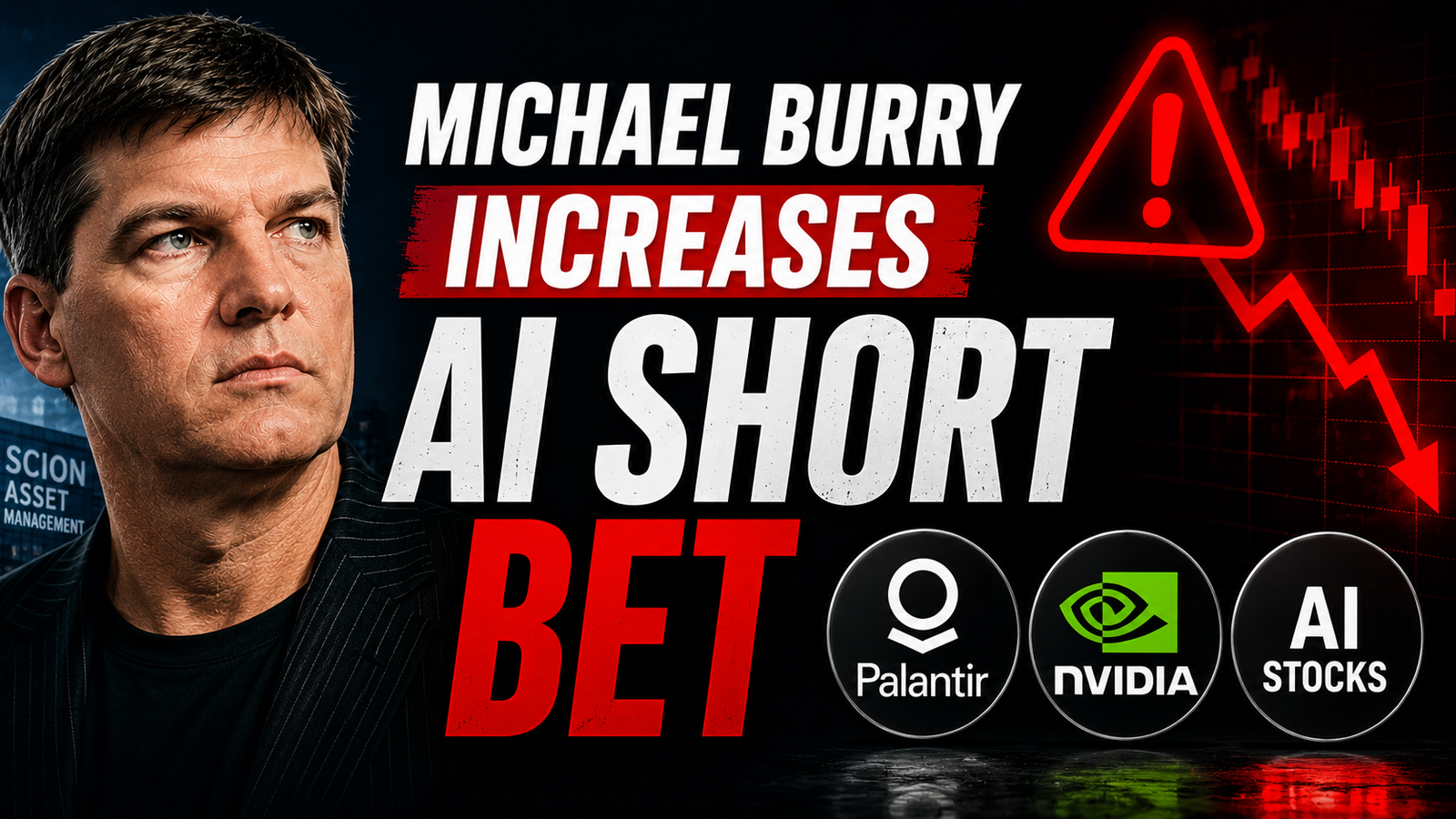
Michael Burry Shorts Palantir and AI Stocks: Is the Artificial Intelligence Bubble About to Burst?
if you have been following the financial world even a little bit lately, you probably know the name Michael Burry. This is the guy who literally predicted the 2008 financial crisis before almost anyone else saw it coming. He made a billion-dollar bet against the housing market, everyone laughed at him, and then the entire global financial system collapsed. He was right. And now, in my opinion, what he is doing today deserves every investor’s attention, whether you are a seasoned trader or just someone trying to protect your savings.
Because here is the thing. Michael Burry just significantly increased his short bet against artificial intelligence stocks, and the numbers involved are honestly pretty staggering.
What Exactly Did Michael Burry Do?
So on Monday, Burry came out and confirmed two pretty major moves. First, he completely sold off his entire GameStop position, which most people know as the ticker symbol GME. Second, and this is the big one, he opened what is called an outright short on Palantir Technologies, traded under the ticker PLTR.
Now for those who might not be super familiar with short selling, think of it this way. When someone shorts a stock, they are essentially placing a bet that the price of that stock is going to go down. If they are right, they make money. If they are wrong, they can lose quite a bit. So when a guy like Michael Burry, with his track record, puts a massive short position on a company, people tend to sit up and pay attention.
Why Did He Dump GameStop?
According to Burry himself, the reason he walked away from GameStop is that the company’s proposed deal with eBay simply does not fit with his so-called “Instant Berkshire” investment thesis. In simpler terms, he had a specific vision for what GameStop could become, kind of like a lean, efficient holding company similar to Berkshire Hathaway. But the eBay deal, in his view, involves too much leverage and too many questionable acquisition assumptions that just do not line up with that vision. So he walked away completely.
Why Is He Shorting Palantir So Aggressively?
This is where things get really interesting, in my opinion. Burry is not just saying Palantir is a little overpriced. He is saying the company, at its current valuation, is worth “low double digits at best,” which translates to roughly around 46 to 50 dollars per share. And what really caught my attention is that he is not just shorting the stock price. He is shorting the actual business model itself. That is a very strong statement from someone of his caliber.
This new outright short position on Palantir builds on top of an already enormous bearish AI bet that Burry disclosed through Scion Asset Management’s Q3 2025 13F filing. That filing showed he held approximately 912 million dollars in notional put options on Palantir and another 187 million dollars in put options on Nvidia. We are talking about a total bearish bet of around one billion dollars, and he has now expanded it further.
The Fresh Additions to His Portfolio
Beyond Palantir, Burry also disclosed some brand new bearish put positions on several other major names. These include the SOXX semiconductor ETF, the QQQ Nasdaq-tracking ETF, Nvidia again under the ticker NVDA, and Oracle under ORCL. What I find particularly notable here is that all of these new puts have expiration dates stretching out to 2027, and the strike prices are set well below where these stocks are currently trading. He is clearly thinking long-term with this one.
When you add everything up, his outright short positions on Palantir and Tesla together represent around 2.5 percent of his total portfolio. His broader put options across other AI and tech-linked stocks account for another 7 percent. So we are looking at roughly 9.5 percent of his entire portfolio betting against the AI sector.
What Does This Mean for You as an Investor?
Now I want to be very clear here. This article is not financial advice, and I am definitely not telling you to run out and short AI stocks right now. But I do think there is something genuinely useful in watching what someone like Burry is doing, especially when you consider his track record.
Think of it this way. Burry has previously compared the current AI boom to the late 1990s dot-com bubble. Back then, everyone was pouring money into internet companies with sky-high valuations and very little actual profit. A lot of those companies eventually collapsed. His concern seems to be that we might be in a similar situation today, where the excitement around AI has pushed valuations far beyond what the underlying business models can actually support.
For everyday investors and readers, the practical takeaway here is worth thinking about. It might be a good time to review your own portfolio and ask yourself how much exposure you have to high-valuation AI stocks. Diversification, as always, remains your best friend in uncertain times.
Read More:





2 Comments