
Why Big Tech Is Quietly Pulling Back on AI: The Hidden Cost Crisis Nobody Warned You About
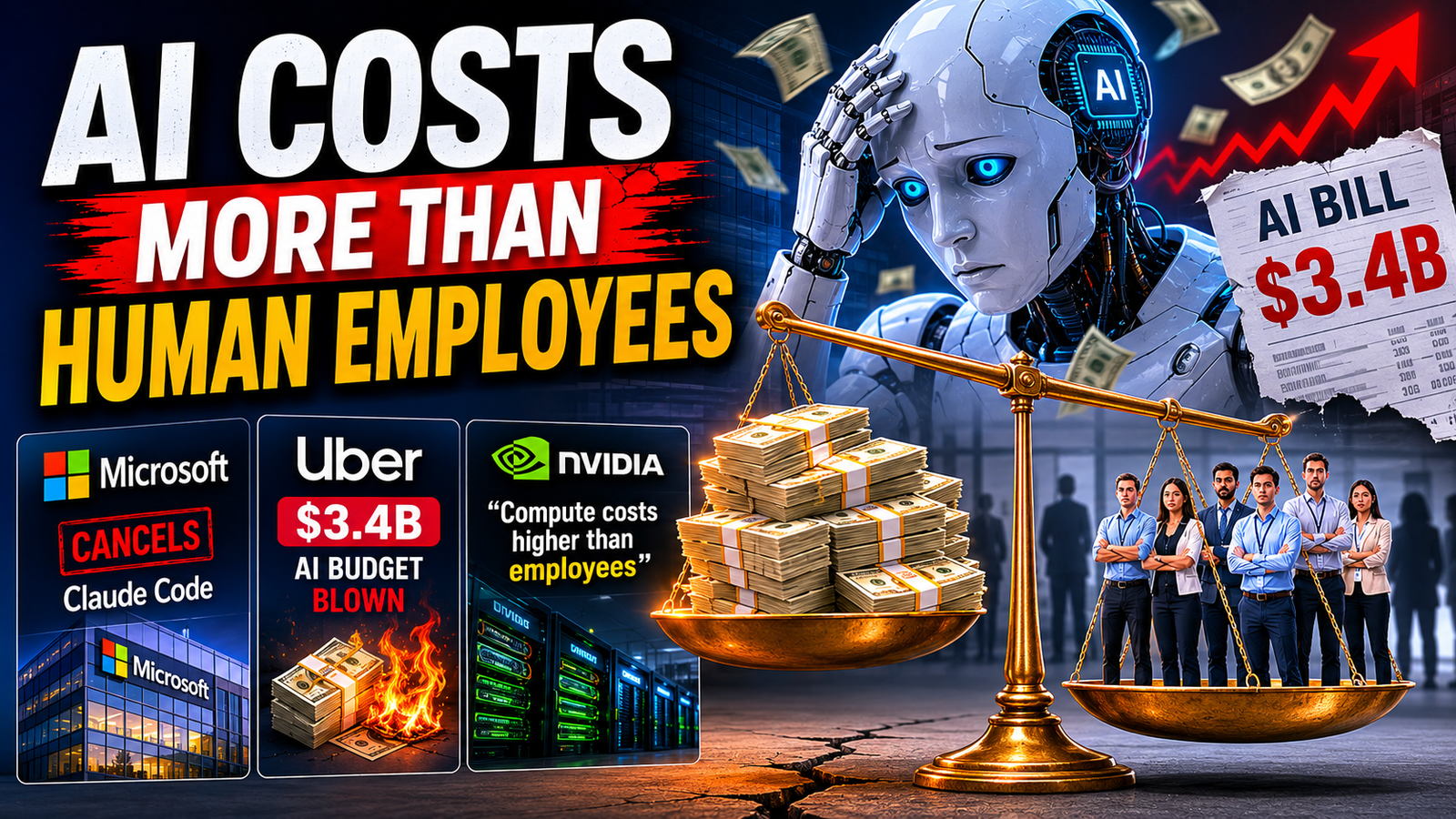
If you have been following the AI story over the past two years, you were probably told the same thing again and again: AI saves money, AI replaces expensive humans, AI is the future of efficiency. Well, in my opinion, the story has just taken a very sharp and very interesting turn, and I think every investor, every salaried professional, and every business owner genuinely needs to understand what is happening right now.
AI Is Costing More Than the Humans
According to verified reporting from Fortune, The Verge, TechRadar, and The Information, three major developments have happened in recent weeks that, together, tell a story Wall Street has not fully priced in yet.

Microsoft just cancelled the majority of its internal Claude Code licences across its Experiences and Devices division, the team responsible for Windows, Microsoft 365, Outlook, Teams, and Surface. Uber burned through its entire 2026 AI budget in just four months. And an executive at Nvidia, the very company that sells the chips powering all of this AI, publicly admitted that compute costs for his team are now higher than what the company pays its own employees.
What Actually Happened at Microsoft
Here is the verified timeline. In December 2025, Microsoft opened up access to Claude Code, an AI coding assistant made by Anthropic, to thousands of its engineers across the Experiences and Devices division. According to reporting by The Verge’s Tom Warren and confirmed by TechRadar, engineers loved it and adopted it very fast. Perhaps, as Tom Warren put it, a little too fast.
The tool became so popular that engineers were choosing Anthropic’s product over Microsoft’s own GitHub Copilot CLI. Claude Code was winning on merit. And that is precisely when the problem started.
On 14 May 2026, an internal directive went out from Rajesh Jha, Microsoft’s Executive Vice President. The message, according to TheStreet and confirmed across multiple outlets, was clear: cancel most Claude Code licences by 30 June 2026, the last day of Microsoft’s fiscal year, and switch everyone over to GitHub Copilot CLI instead.
Now, Microsoft has framed this publicly as “toolchain unification.” And I think there is some truth to that. But the timing, the fiscal year end, and the pattern we are about to show you with Uber and Nvidia suggest something bigger is going on here.
One important clarification worth noting: this does not end Microsoft’s relationship with Anthropic. Microsoft has invested up to $5 billion in Anthropic, and Claude models will still be accessible inside Copilot and other Microsoft products. It is just the standalone Claude Code interface that is going away internally.
The Uber Story: An Entire Year’s Budget, Gone in Four Months
If Microsoft’s story feels like a controlled corporate pivot, Uber’s story feels more like a genuine budget emergency.
Uber deployed Claude Code to around 5,000 engineers starting in December 2025. What happened next was, depending on how you look at it, either a huge success or a financial shock.
By April 2026, between 84 and 95 percent of Uber’s engineers were actively using the tool every single month, according to reports cited by People Matters and confirmed by The Information. That is an adoption rate that most enterprise software deployments can only dream of. For context, getting 30 percent of employees to regularly use a new tool is normally considered a success.
Engineers were not just dabbling with it either. They were using it constantly. Individual engineers were spending between $500 and $2,000 per month each on API tokens. Uber’s own CTO, Praveen Neppalli Naga, reportedly spent $1,200 in a single two-hour demo session, according to The Information.
And the usage translated into real output. According to reporting by The Next Web, around 70 percent of all code committed at Uber was now coming from AI, with roughly one in ten live backend updates being shipped by an AI agent with zero human involvement in the loop.
So the tool was working. And that was exactly the problem.
By April 2026, Uber had burned through its entire $3.4 billion 2026 AI budget with eight months still remaining in the year. Naga publicly told The Information that the budget he thought he would need had been “blown away already.”
I think the way to understand this is simple. Token-based pricing means every single query, every code review, every debugging session, and every automated update costs money. When 84 to 95 percent of your 5,000 engineers are doing this constantly, every day, the numbers compound at a speed that is genuinely hard to forecast in advance.
The Nvidia Admission That Changes Everything
Here is the part of this story I personally find most striking.
Bryan Catanzaro is the Vice President of Applied Deep Learning at Nvidia. Nvidia is not just a tech company. Nvidia is the company that manufactures the GPUs that make AI run. They are, in essence, selling the shovels in this gold rush.
And in late April 2026, Catanzaro told Axios something that should be read very carefully. He said that for his team, the cost of compute is “far beyond the costs of the employees.”
This quote is worth sitting with. The person leading applied deep learning at the company that sells AI chips, who presumably has unlimited access to AI infrastructure, is saying that using AI at his level costs more than paying the people who use it.
A 2024 study from MIT, cited by both Fortune and Entrepreneur, supports this finding. Researchers found that AI automation would be economically viable in only about 23 percent of roles where vision is a primary component of the work. In the remaining 77 percent of situations, it was simply cheaper to continue using human labor.
What the Forecasts Actually Say About Future Costs
Now I want to be careful here, because I think this story is nuanced and I do not want to just give you a doom narrative. Let us look at what the actual analysts and research firms are forecasting.
Goldman Sachs recently published research projecting that AI agent adoption will drive a 24-fold increase in global token consumption by 2030, potentially reaching 120 quadrillion tokens processed per month. The bank sees this as a positive development for hyperscalers and chip companies, because as token demand rises, compute margins should improve.
Separately, research firm Gartner estimates that by 2030, the cost to run inference on a large language model could fall by close to 90 percent compared to 2025 levels. That sounds like good news for enterprise budgets.
However, and this is the critical part that I think most business coverage is missing, Gartner also warns that lower unit costs will not necessarily reduce overall enterprise AI bills. The reason is straightforward: agentic AI models require far more tokens per task than simpler chatbot-style tools. The heavier usage can more than offset the cheaper per-token pricing, especially as companies keep expanding their AI workloads. In other words, you pay less per token but you use so many more of them that the total bill goes up anyway.
Gartner has also placed generative AI in what it calls the “trough of disillusionment” in its 2026 hype cycle, predicting that around 25 percent of planned 2026 AI budgets will be pushed into 2027 as proof-of-concept projects fail to survive the procurement process. A separate Gartner finding from April 2026 noted that only 28 percent of AI infrastructure projects fully deliver against their stated business case.
What This Means for You as an Investor or Business Owner
I think this is where the story gets genuinely useful for readers here at Zurvik.com
If you are an investor: The narrative that AI will immediately reduce enterprise headcount and operating costs is being challenged by real-world deployment data. Companies like Microsoft, Uber, and even Nvidia are discovering that heavy, genuine adoption of AI tools creates a new and unpredictable category of operating expense. Quarterly earnings could start showing more volatility in software and infrastructure costs as AI usage grows. The stocks that were rewarded for announcing AI adoption may face harder questions about whether that adoption is actually profitable at scale.
If you are a business leader: The key lesson from Uber is not that AI tools are bad. The tool clearly worked. 84 to 95 percent adoption and 70 percent of code coming from AI is extraordinary by any measure. The lesson is that token-based pricing at scale requires a fundamentally different kind of budgeting than traditional software licences. You cannot simply buy seats and set a flat annual cost. Every query is a metered expense, and if your team genuinely adopts the tool, your costs will scale with that adoption in ways that traditional forecasting models are not designed to handle.
If you are a salaried professional in tech: The AI cost problem is, in a strange way, good news for your near-term job security. The math of replacing humans with AI is harder than it looks, and real-world data is making that clearer. However, I think the honest read is that this is a temporary friction, not a permanent ceiling. Prices will fall. The economics will eventually shift. The question is when, and what that transition period looks like for different types of roles.
The Bigger Picture: A Gap Between the Story and the Numbers
I want to be transparent that this story has some complexity that deserves acknowledgment.
Microsoft is not abandoning AI. It is switching from a third-party tool to a cheaper one it already owns. That is a rational business decision, not a retreat from the technology.
Uber burned through its budget not because AI failed, but because it succeeded so well that adoption exploded beyond what anyone planned for. That is a forecasting problem more than a technology problem.
And Goldman Sachs, for what it is worth, is broadly optimistic about the long-term economics of AI as compute costs fall and agentic productivity rises.
But what I think is genuinely new here, and genuinely worth paying attention to, is that the companies at the frontier of real-world AI deployment are discovering that the unit economics do not yet work at current token prices when adoption is high. The more your team uses AI, the higher the bill. And the bills are arriving faster than most finance teams anticipated.
Big Tech has committed approximately $740 billion in AI-related capital expenditure in 2026, a 69 percent jump from the year before, according to figures from Morgan Stanley cited by Fortune. That is a staggering amount of capital being deployed behind a bet that the economics will improve.
In my opinion, they probably will improve. But the gap between the current reality and the story being told on earnings calls is real, and it is worth watching closely.
Quick Summary
Here is what has been verified from credible sources for this article:
Microsoft cancelled the majority of Claude Code licences across its Experiences and Devices division on 14 May 2026, directing engineers to GitHub Copilot CLI instead, with a deadline of 30 June 2026.
Uber deployed Claude Code to around 5,000 engineers in December 2025. By April 2026, 84 to 95 percent of engineers were active users, spending between $500 and $2,000 per month each. The company exhausted its entire $3.4 billion 2026 AI budget in approximately four months.
Nvidia’s Bryan Catanzaro told Axios in April 2026 that compute costs for his team are “far beyond the costs of the employees,” a significant admission from a senior leader at the company selling the underlying infrastructure.
Goldman Sachs forecasts a 24-fold increase in global token consumption by 2030, reaching 120 quadrillion tokens per month, driven by enterprise AI agent adoption.
Gartner projects token unit costs could fall by close to 90 percent by 2030, but warns total enterprise AI costs will likely increase as agentic workloads consume far more tokens per task.
MIT research from 2024 found AI automation is economically viable in only 23 percent of vision-primary roles, with human labor remaining cheaper in most other situations.
The Bottom Line
The AI efficiency story is not over. But it is getting more complicated, and more honest.
The companies that deployed AI tools most successfully, like Uber, did so well that they ran out of money. The companies that invested most heavily in AI infrastructure, like Microsoft, are discovering their own tools are sometimes cheaper and good enough. And the companies selling the AI chips, like Nvidia, are watching their own internal teams spend more on compute than on salaries.
According to me, the smartest thing any investor, business owner, or professional can do right now is pay very close attention to the gap between what companies say about AI on earnings calls and what the actual cost data from their finance teams is telling them. That gap is where the real story lives.
And based on what Microsoft, Uber, and Nvidia have shown us in just the past few weeks, that gap is wide.
Read More:







2 Comments